

close
Choose Your Site
Global
Social Media


| Quantity: | |
|---|---|


Customized
MingHeng
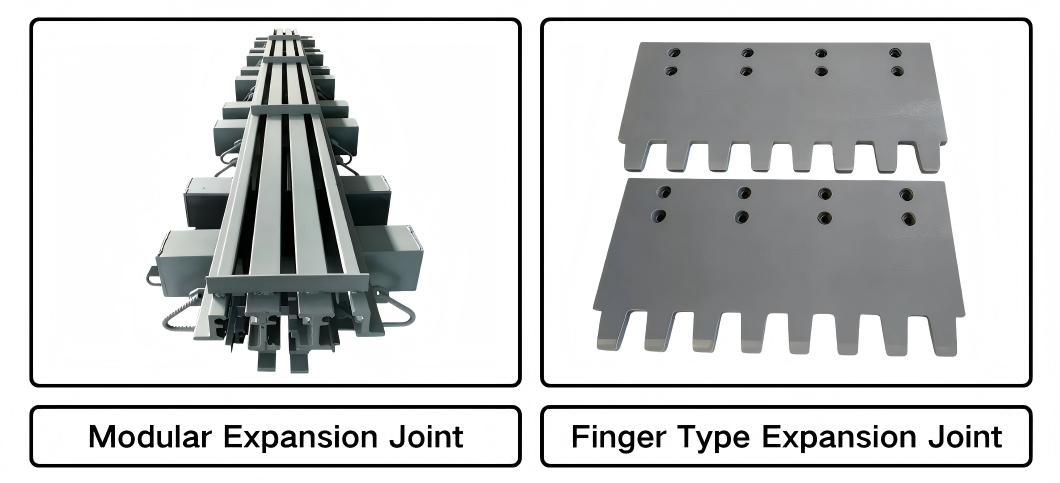
Joint Type Comparison
| Comparison | Modular Expansion Joint | Finger Type Expansion Joint |
| Displacement Accommodation | Large cumulative displacement, expandable by adding modules | Large single gap displacement, finger gaps open and close with temperature |
| Load Bearing Structure | Steel framework support, intermediate beams carry wheel loads | Intermeshed finger plates form continuous load bearing surface |
| Waterproofing | Rubber sealing strip fixed in steel profile grooves | Drainage channels beneath finger plates, self cleaning |
| Driving Experience | Slight vibration at sealing strip locations | Continuous flat surface, smooth passage |
| Maintenance | Sealing strips replaceable in sections | Finger plates replaced after wear, longer maintenance intervals |
| Suitable Applications | Large displacement, heavy traffic, railway bridges | Long spans, high driving comfort requirements |
Both joint types can be selected based on actual project requirements, with displacement capacity, profile specifications and finger plate parameters all available for customization.
Selection Considerations
Selection of bridge expansion joints involves multiple engineering factors:
Displacement Capacity: Design expansion range is the primary parameter for joint type selection. Modular expansion joints cover a wide displacement range by adjusting the number of intermediate beams, while finger type expansion joints suit medium to large displacement requirements.
Traffic Load: Under heavy or high frequency traffic conditions, the steel framework of modular expansion joints performs robustly in terms of load bearing redundancy. Finger type expansion joints carry wheel loads directly on the finger plate surfaces, requiring sufficient plate thickness and tooth strength.
Driving Comfort: For road sections with higher driving experience requirements, the continuous finger plate surface of finger type expansion joints provides a smoother transition.
Drainage Requirements: The open tooth base structure of finger type expansion joints allows rainwater and debris to drain naturally, making them suitable for bridge decks sensitive to water accumulation.
Maintenance Conditions: The sealing strips of modular expansion joints can be replaced in sections without interrupting traffic. Finger type expansion joints have longer replacement intervals for finger plates but involve greater work volume per maintenance event.
Application Scenarios
Bridge expansion joints are widely used at deck joint locations of highway bridges, urban viaducts, railway bridges, and interchange projects. Modular expansion joints are commonly seen on medium to large span heavy traffic arterial roads and railway bridges, while finger type expansion joints are often used on long span suspension bridges, cable stayed bridges, and urban landscape bridges with higher driving comfort requirements. Both joint types have proven applications in new bridge construction, renovation, and expansion joint replacement projects.
Installation & Maintenance
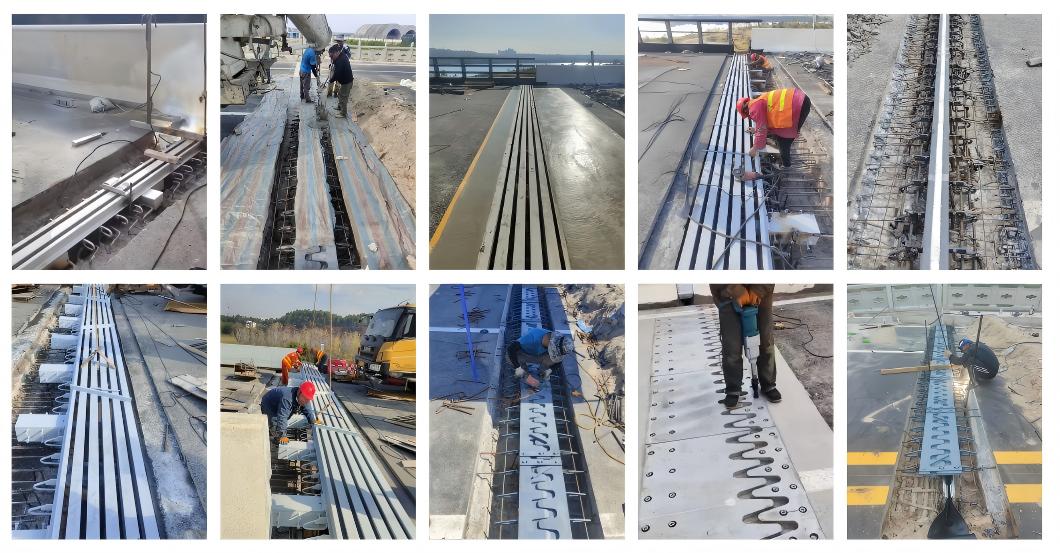
Expansion joint installation should be carried out in the pre reserved groove before or after deck pavement according to design. The centerline of the joint should align with the bridge expansion joint centerline, and welding temperature should be controlled to avoid base material damage. Concrete filling in the anchorage zone should be dense, with vehicle access prohibited during curing.
For routine maintenance, modular expansion joints require periodic inspection of sealing strips for aging or damage, with prompt replacement upon signs of leakage. Finger type expansion joints should be checked for loose, fractured, or excessively worn finger plates, with drainage channels kept clear. In cold winter regions, snow and ice in the joint should be removed promptly to prevent structural deformation from frost heave.


