

close
Choose Your Site
Global
Social Media


| Quantity: | |
|---|---|


Product Advantage
◆◆ Characteristics of LRB Lead Rubber Bearing:
1. Bilinear stiffness property: Under the action of small horizontal forces, the initial stiffness is relatively high with minimal deformation. When an earthquake occurs, the lead core yields, and the stiffness decreases significantly (the post-yield stiffness is 1/10 to 1/20 of the initial stiffness), which extends the structural period and reduces the transmission of seismic forces.
2. Stable energy dissipation capacity: The hysteresis curve shows a spindle-shaped antisymmetric distribution. Energy is dissipated through the plastic deformation of the lead core, and the equivalent damping ratio can reach 20%-30%, which is superior to that of ordinary rubber bearings. The energy dissipation capacity increases with the increase in the diameter or quantity of lead cores.
3. Self-centering function: After an earthquake, the lead core undergoes dynamic recovery and recrystallization processes. Combined with the rubber shear tension, it can drive the structure to reset automatically without manual intervention.
4. High cost-effectiveness: It integrates seismic isolation and energy dissipation functions, eliminating the need for additional dampers. The construction process is simple, and the comprehensive cost is lower than the combined scheme of ordinary rubber bearings and dampers.
5. Strong durability: The rubber and lead materials are corrosion-resistant, with a design service life of more than 50 years, making them suitable for complex environments such as humidity and high temperatures.
6. Excellent stability: The steel plate interlayer effectively prevents the lateral buckling of the bearing, ensuring the structural safety under large deformations (the horizontal displacement can reach 200%-300% of the bearing height).
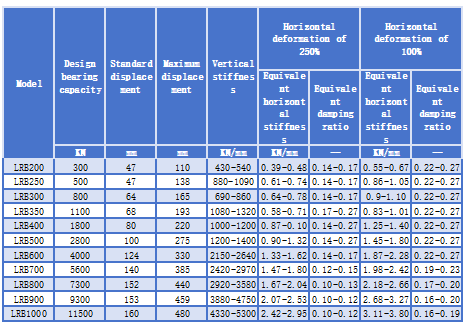
Technical Parameters
Product Uses
◆◆ Application Scenarios of Lead Rubber Bearings (LRBs)
Lead rubber bearings (LRBs) have been applied in various engineering projects due to their excellent mechanical properties and relatively simple structure. The applicable scenarios of lead rubber bearings are as follows:
1. Building engineering: Lead rubber bearings are suitable for building engineering. They can provide excellent seismic isolation effects and protect the safety of buildings during natural disasters such as earthquakes.
2.Steel structure buildings: Lead rubber isolation bearings (e.g., the LRB series) are widely used in steel structure buildings such as trusses, connecting corridors, space grids, overpasses, steel roofs, and membrane structures. They can effectively absorb seismic energy and reduce the impact of earthquakes on the superstructure.
3. Highway, railway, and bridge engineering: Lead rubber bearings are applicable to transportation engineering projects including highways, railways, and bridges. They can bear large vertical bearing capacity and horizontal restoring force, ensuring the stability and safety of the structure.
4. Industrial and mining enterprises: Lead rubber bearings are also suitable for buildings and facilities in industrial and mining enterprises. They provide necessary seismic isolation and vibration reduction functions to ensure the safety of production and operation.
To sum up, due to their excellent mechanical properties and simple structure, lead rubber bearings have been widely used in multiple fields such as building engineering, steel structure buildings, transportation engineering, and industrial and mining enterprises.
Product Operate Guide
◆◆ Installation Procedure for Lead-Rubber Bearings (LRB)
Follow the principles of "precise positioning, symmetrical construction, and strict standard control", and carry out the operation in 4 phases:
Phase 1: Pre-installation Preparation
Verification
- Check the bearing model and the condition of rubber/lead cores against the design drawings.
- Measure the flatness of the bearing pad (≤1mm/m) and elevation (≤±2mm), and clean the bolt holes.
Material Preparation
- Prepare tools and materials such as level, jack, torque wrench, non-shrink grout, sealant, etc.
Phase 2: Bearing Positioning and Adjustment
1. Hoist the bearing to align with the center of the bearing pad, and perform initial positioning (axis deviation ≤5mm).
2. Adjust the flatness using a 2m straightedge and thin steel sheets (gap ≤5mm, no more than 3 layers of steel sheets), and verify the elevation with a level (deviation ≤±1mm).
3. Conduct final positioning (axis deviation ≤2mm) and temporarily fix the bearing to prevent displacement.
Phase 3: Fixing and Sealing
1. Insert the bolts and pre-tighten them (to 50% of the designed torque), inject grout from one side until it overflows from the other side, and cure for ≥7 days.
2. After the grout reaches 80% of its designed strength, symmetrically tighten the bolts according to the designed torque.
3. Fill the gaps with polyurethane sealant to ensure waterproofing.
Phase 4: Inspection and Acceptance
- Inspect the axis (≤2mm), flatness, elevation, bolt torque, grout compactness, and sealing quality.
- File the records if the bearing passes the inspection.
Key Reminders
- Do not knock the rubber/lead cores.
- The installation temperature should be 5-35℃.
- Conduct symmetrical operations to prevent eccentric pressure.
- Perform regular inspection and maintenance.
FAQ
1. What are your main products?
Our main products include: Anti-Seismic Flexible Pipelines ;Bridge Bearings;Bridge Expansion Joints ;Sealants ; Waterstops
2. Can you provide customized products?
Absolutely! We offer tailored solutions based on your project’s specific requirements, covering everything from material selection (such as NBR, EPDM, and more) to structural design. All custom orders come with detailed technical drawings and professional installation guides to ensure seamless implementation.
3. What certifications does your company possess?
We hold ISO certifications for quality, environmental, and occupational health management systems, ensuring strict compliance with GB/T 17955-2019 and other national standards.
4. Do you offer installation support?
Yes, we provide after-sales support, including remote video guidance for installation.


